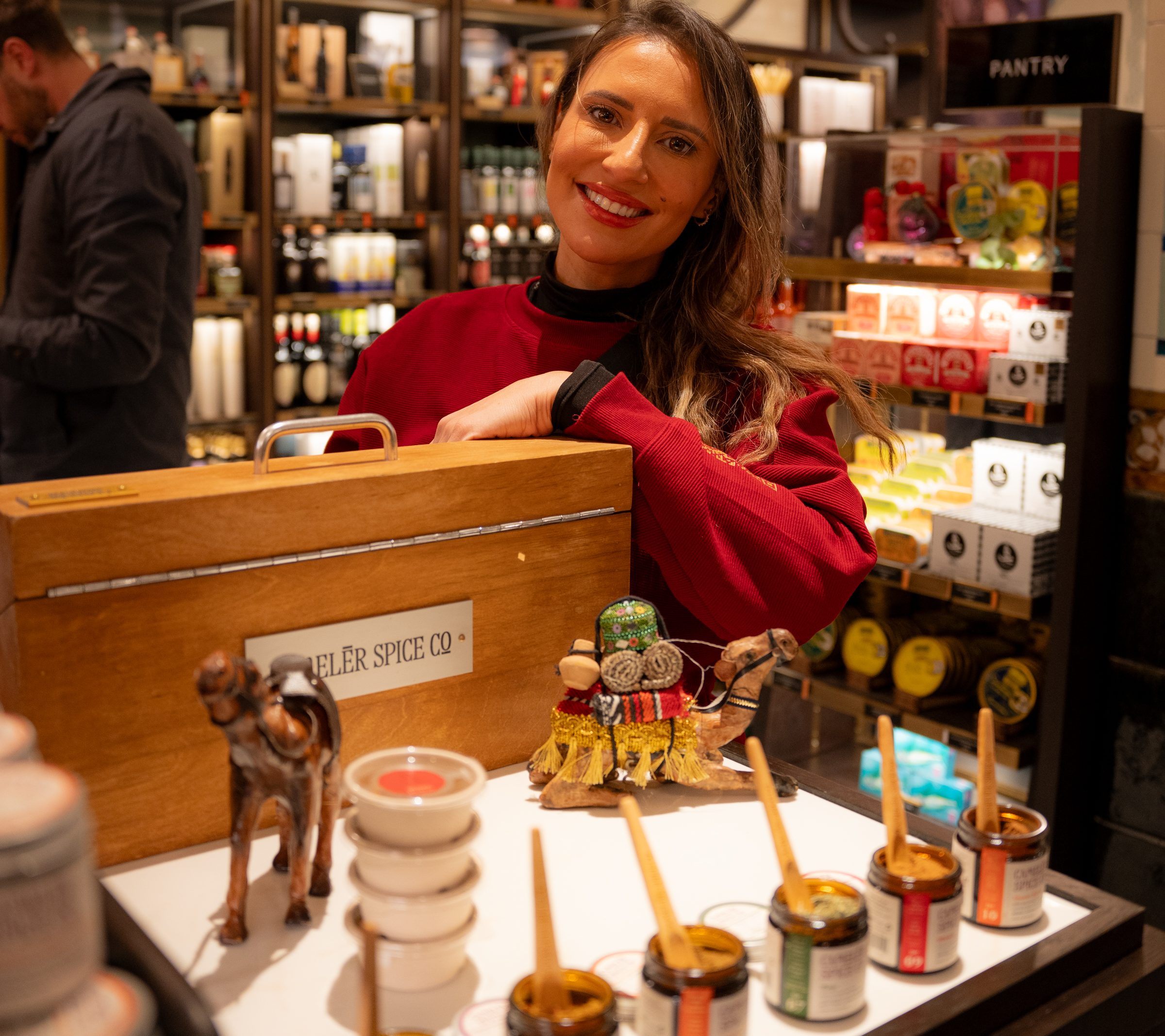
Halle Faraj is a British-Saudi chef, spice alchemist, and co-founder of Camelēr Spice Co., a contemporary heritage food brand now stocked in premium retail. Through her work, she explores how flavour carries memory, identity and place into modern spaces, building a business that thoughtfully bridges culture and commerce. With a background spanning science, media and branding – from beauty formulation to shaping cultural narratives –Halle brings a layered, cross-disciplinary perspective to everything she creates. Raised between cultures and industries, her approach sits somewhere between instinct and structure and heritage and modernity, as she navigates what it means to build something both meaningful and ambitious.
Can you introduce yourself and share the journey that led you to where you are today? What were the pivotal stages in building your brand within the food, drink, or FMCG landscape?
I’m Halle Faraj, a Saudi-British chef, marketer and co-founder of Camelēr Spice Co. My relationship with spices began by watching my grandmother cook. She could not read or write, yet she had an extraordinary palate. She blended by feel, by scent, by memory. There were no recipes. Only instinct.
At the time, I did not understand how formative that was. I only understood it later, when I realised that what she carried in her senses could not be replicated by packaging alone. It required intention.
Years later, I trained professionally and worked in scientific formulation. I learned structure, measurement and discipline. Camelēr sits between those two worlds. It carries heritage and instinct, but also precision and commercial reality. The real shift came when the idea had to survive the real world. Co-founding Camelēr with Myles Grennan was a pivotal stage. What began as a concept became a business we were building together. My creative instinct met his operational discipline, and the brand strengthened through that balance.
Camelēr stopped being just a vision and became something shaped through discussion, strategy and structure. Building a supply chain across multiple countries. Managing minimum order quantities while protecting cash flow. Negotiating with retailers who needed proof of velocity before belief. Securing our first premium listing. Achieving B Corp certification, which required us to formalise policies, documentation and impact tracking. Each stage required us to grow as founders while protecting the heart of why we started.
What defining moment shaped your approach to business or leadership?
I still lead with passion. That has not changed. What changed was my understanding of what passion alone can and cannot do. Early on, I believed that if the product was strong enough, it would naturally find its market. It does not work that way.
There was a moment in a retail meeting when I realised I needed to be just as fluent in margins, logistics and promotional strategy as I was in flavour. I was asked about rate of sale expectations, promotional funding and supply resilience. I had answers, but not with the same authority I had when speaking about aroma or origin. That was confronting.
That was not a loss of passion. It was a maturation of it.
Co-founding the business with someone who thinks instinctively in terms of operations and strategy sharpened that shift. It required me to translate intuition into numbers and ideas into structure. To justify pricing. To defend margin. To plan six months ahead rather than six days. Leadership became about holding both. Creative conviction alongside commercial discipline. Not choosing one over the other, but strengthening each through the other.
The FMCG space is highly competitive and margin-sensitive. How do you approach growth commercially and personally?
FMCG can humble you quickly. It is a sector where you can grow revenue and still lose money. We are careful. We focus on premium positioning and healthy unit economics. Not every retailer is right for us. We have turned down opportunities where projected volume would have required discounting beyond sustainable levels or stretched production capacity too thin.
Distribution without sell-through is not growth. It is exposure. We model margins conservatively. We factor in promotional spend before it is requested. We plan inventory against cash, not optimism. Personally, I have had to learn not to ride every high and low. Some weeks feel expansive. Others feel slow. A strong reorder can feel validating. A delayed listing can feel personal.
You cannot let either define you. Emotional steadiness has become part of the job.
What does building with intention mean to you in a category driven by volume and velocity?
Building with intention means knowing what you will not compromise, especially when growth starts accelerating.
In a category driven by volume, there is constant pressure to move faster, produce more, simplify messaging, or dilute positioning to appeal to everyone. For us, intention is about clarity. We know who we are and who we are not for.
It shows up in decisions like packaging in brown glass because it protects freshness and reflects permanence. It shows up in traceability, in publishing our ingredient index and being transparent about sourcing, even when that level of detail is not required. It shows up in pursuing B Corp certification, even when it adds operational complexity and external scrutiny.
It shows up in resisting the urge to launch endlessly and instead refining what already exists. Trust is built when customers sense coherence. When the story, the product and the operations align. Scale should amplify identity, not blur it. If the brand feels different at ten thousand units than it did at one hundred, something has been lost.
Resilience is critical in this sector. What have been your most valuable lessons in navigating uncertainty?
There have been shipment delays, cost increases and retail conversations that did not go the way we expected. None of it is extraordinary. It is just part of the job. The biggest lesson has been to stay practical. Look at the numbers. Protect cash earlier than feels necessary. Speak to suppliers before there is a problem, not after.
We moved from reactive ordering to forward planning inventory several months ahead to reduce exposure. And never negotiate when you are emotional. As co-founders, we have also learned that uncertainty tests alignment. There are moments when you disagree strongly, and moments when you have to present one clear position externally.
Knowing the difference matters. Internal tension can strengthen a business if it remains respectful and data-led. Resilience is less about strength and more about discipline. Showing up again the next day, even when nothing has gone smoothly.
How do you balance ambition with wellbeing in an industry that rarely slows down?
There was a period when I equated busyness with progress. I was constantly responding, constantly reacting. It was not sustainable. Now I protect thinking time. I train. I review finances weekly rather than monthly, so there are no surprises. I schedule space away from operational noise to look at strategy rather than just tasks.
Wellbeing is not separate from performance. If the founder is scattered, the company will be too. Structure in my personal life has become as important as structure in the business.
What does legacy look like in your work?
Legacy for me is not just scale or exit. It is proving that a brand rooted in heritage and ethics can compete commercially. My grandmother never built a company, but she built something more important. She passed down knowledge without ever writing it down. If Camelēr can carry that kind of continuity forward, while operating responsibly in a modern market, that feels meaningful.
It also means building something that outlasts trend cycles. A brand that retailers respect commercially, suppliers trust contractually, and customers return to because it feels consistent. Legacy is durability.
What advice would you give to women building their next chapter in food, drink, or FMCG?
Stop waiting to feel ready. This industry does not reward perfection. It rewards movement. If you wait until you understand manufacturing, funding, distribution and margin completely, you will delay yourself indefinitely.
At the same time, do not confuse visibility with power. Press, panels and even retail listings can look impressive, but the real strength of a business is built quietly in negotiation rooms, in spreadsheets, in uncomfortable conversations about cash. It is built in understanding your contribution margin and knowing exactly how far you can discount without compromising survival. And here is something I learned later than I would have liked. You do not need to harden yourself to be taken seriously. I used to believe composure meant shutting emotion down. It does not.
Vulnerability, when paired with competence, is strength. Being honest about what you are learning, where you are stretching, and what you will not compromise builds trust. It attracts better partners. It filters out noise. Do not armour yourself so heavily that you lose your instinct. Just make sure your instinct is supported by skill.
https://camelerspiceco.com
https://instagram.com/camelerspiceco